
What Is Biblical Fellowship? Practices for Church Community

Biblical fellowship practices in church form the heartbeat of Christian community. Yet for many believers, fellowship remains something vague—a friendly coffee hour or casual conversation after worship. Scripture, however, reveals fellowship as something far more intentional, transformative, and costly. True biblical fellowship involves shared spiritual purpose, mutual accountability, sacrificial love, and authentic presence with one another. This article explores what biblical fellowship actually means and how you can cultivate it within your church community today.
Thank you for reading this post, don't forget to subscribe!What Is Biblical Fellowship?
The Greek word koinonia, translated as “fellowship” or “communion,” appears frequently throughout the New Testament. According to Blue Letter Bible’s lexical resources, koinonia means participation, sharing, and partnership—not merely social interaction. When Paul writes in 1 Corinthians 1:9, “God is faithful, by whom ye were called unto the fellowship of his Son Jesus Christ our Lord,” he describes a binding relationship rooted in Christ’s redemptive work.
Biblical fellowship transcends personality compatibility or shared interests. It is a covenant bond formed in the Spirit of God. When believers gather in biblical fellowship, they participate together in the life and mission of Jesus Christ. This means sharing burdens, celebrating victories, speaking truth, offering correction with love, and holding one another accountable to Scripture.
In the early church, this fellowship was so real and practical that believers “had all things common; and sold their possessions and goods, and parted them to all men, as every man had need” (Acts 2:44-45, KJV). This does not mean every Christian community must practice complete economic sharing today, but it illustrates the radical commitment behind true koinonia—willingness to sacrifice personal comfort for the spiritual welfare of others.
The Theological Foundation of Fellowship
Biblical fellowship rests on three theological pillars: our shared identity in Christ, the indwelling Holy Spirit, and the mission of the Kingdom.
First, fellowship flows from our identity in Christ. You are not joined to other believers primarily because you enjoy them or find them convenient. You are grafted into the body of Christ, making every believer your spiritual sibling. As Paul reminds us, “For as the body is one, and hath many members, and all the members of that one body, being many, are one body: so also is Christ” (1 Corinthians 12:12, KJV). This organic unity means isolation contradicts your very nature as a Christian.
Second, the Holy Spirit enables and sustains fellowship. When you were born again, the same Spirit that dwells in every other believer entered you. This shared indwelling creates a supernatural bond that transcends cultural, economic, racial, and generational differences. The Spirit produces fruit in community—love, joy, peace, patience, kindness—that makes genuine fellowship possible. Crossway’s explanatory article on the Holy Spirit’s role provides deeper theological grounding for understanding this dynamic.
Third, fellowship exists for Kingdom mission. Jesus did not call us to isolate in holy bubbles. Rather, He sent us into the world as His witnesses. Authentic fellowship strengthens believers for this witness. When you are known deeply, prayed for specifically, and held accountable lovingly, you become more fruitful in sharing Christ with others. Community is not the end; it is the means to the greater end of expanding God’s Kingdom.
Core Characteristics of Biblical Fellowship
Scripture reveals several non-negotiable marks of authentic fellowship. Understanding these characteristics helps you evaluate whether your church community is practicing true koinonia or merely religious socializing.
Vulnerability and Authenticity
Genuine fellowship requires removing masks. The apostle James instructs: “Confess your faults one to another, and pray one for another, that ye may be healed” (James 5:16, KJV). This does not mean broadcasting every struggle to the entire congregation, but it does mean being real with at least some believers in your church. You cannot fellowship authentically while pretending everything is fine. True community creates safe spaces where doubt, failure, grief, and fear can be expressed and met with compassion.
Mutual Accountability
Fellowship includes speaking truth to one another. Proverbs 27:12 states, “As iron sharpeneth iron; so a man sharpeneth the countenance of his friend” (KJV). This means loving brothers and sisters enough to offer gentle correction when someone drifts from Scripture or harmful patterns emerge. Accountability is not judgment; it is the refusal to let a fellow believer stumble alone into sin. Learning how to pray for others in your church community becomes the foundation for offering accountability with love rather than condemnation.
Shared Burdens and Rejoicing
Paul writes in Romans 12:15: “Rejoice with them that do rejoice, and weep with them that weep” (KJV). Biblical fellowship means genuinely entering into one another’s joys and sorrows. When a sister receives news of her child’s conversion, the community celebrates as if it were their own. When a brother faces a medical crisis, the church grieves and intercedes sacrificially. This emotional and spiritual solidarity distinguishes true fellowship from mere politeness.
Sacrificial Generosity
Fellowship expresses itself in material generosity. The Jerusalem church so embodied this that surrounding communities recognized their love by their care for widows, orphans, and the poor. Your willingness to share finances, time, talent, and resources reveals whether you truly see other believers as members of your own body.
Common Doctrine and Purpose
True fellowship is not indifferent about truth. You cannot fellowship equally with those who deny Christ’s divinity, reject His resurrection, or embrace false gospels. As Paul warns, “Be ye not unequally yoked with unbelievers” (2 Corinthians 6:14, KJV). Fellowship requires shared foundational convictions about God’s Word, Christ’s redemption, and the believer’s calling.
Examples of Biblical Fellowship from Scripture
The Bible provides concrete portraits of fellowship in action. These examples guide contemporary practice.
The Early Jerusalem Church (Acts 2:42-47)
Luke describes believers who “continued stedfastly in the apostles’ doctrine and fellowship, and in breaking of bread, and in prayers” (Acts 2:42, KJV). Their fellowship involved gathering regularly, sharing meals, pooling resources, and praying together. They met in homes and the temple. They sold possessions to help the needy. The result? “The Lord added to the church daily such as should be saved” (Acts 2:47, KJV). Their authentic fellowship was so attractive that it became a powerful evangelistic witness.
Paul and Timothy’s Relationship
Timothy was not merely Paul’s subordinate; he was his spiritual son, his beloved co-laborer, his fellow soldier. Paul writes to Timothy with paternal tenderness, reminding him to “be strong in the grace that is in Christ Jesus” (2 Timothy 2:1, KJV). Their fellowship involved prayer, encouragement, instruction, and mutual support across distance and danger. This relationship models how spiritual mentoring deepens fellowship.
Priscilla and Aquila’s Hospitality (Acts 18:24-26)
This married couple exemplifies how fellowship becomes practical. When they encountered Apollos—a gifted teacher with incomplete understanding—they did not publicly shame him. Instead, they “took him unto them, and expounded unto him the way of God more perfectly” (Acts 18:26, KJV). Their home became a place of learning, correction, and deeper spiritual formation. Hospitality and discipleship merged in faithful fellowship.
The Philippian Church and Paul’s Partnership (Philippians 1:3-5)
Paul thanks God for the Philippians’ “fellowship in the gospel from the first day until now” (Philippians 1:5, KJV). Their fellowship was not sentimental; it was active partnership in spreading Christ’s Kingdom. They sent Paul financial support, prayed for him, and endured persecution alongside him. Authentic fellowship participates together in Kingdom work.
Barriers to Biblical Fellowship
Why does genuine fellowship prove so difficult in many churches? Several obstacles commonly block koinonia.
Consumerism. When believers treat church as a service provider—selecting a congregation based on music quality, sermon style, or child care—fellowship suffers. You cannot fellowship with those you view as mere service providers or spiritual entertainment deliverers.
Individualism. Western culture emphasizes personal preference, privacy, and independence. Biblical fellowship contradicts these values at every point. It demands vulnerability, interdependence, and alignment with communal values beyond personal taste.
Superficiality. Many church gatherings remain at surface level: handshakes, small talk, and quick prayers. Meaningful fellowship requires time, intentionality, and willingness to move beyond pleasant conversation into genuine knowing.
Fear of judgment. If a church culture punishes vulnerability or shame rather than extending grace, people will wear masks rather than risk authentic fellowship. Trust must precede transparency.
Doctrinal compromise. Conversely, some churches emphasize correct doctrine without mercy or patience. True fellowship balances doctrinal clarity with pastoral gentleness, protecting truth while extending grace to those still growing in understanding.
Biblical Fellowship Practices for Your Church Community
How do you move from understanding fellowship to practicing it? Here are concrete, actionable approaches grounded in Scripture and tested in faith communities like Celestial Church’s community features.
Establish Prayer Partnerships
Invite one or two others to pray with you weekly—in person or by phone. Share specific prayer requests beyond surface concerns. Pray for one another’s marriages, children, work struggles, spiritual growth, and deepening faith. As you intercede for others, your hearts knit together supernaturally. Learn specific ways to pray for others in your church community and the transformative power of intercessory prayer.
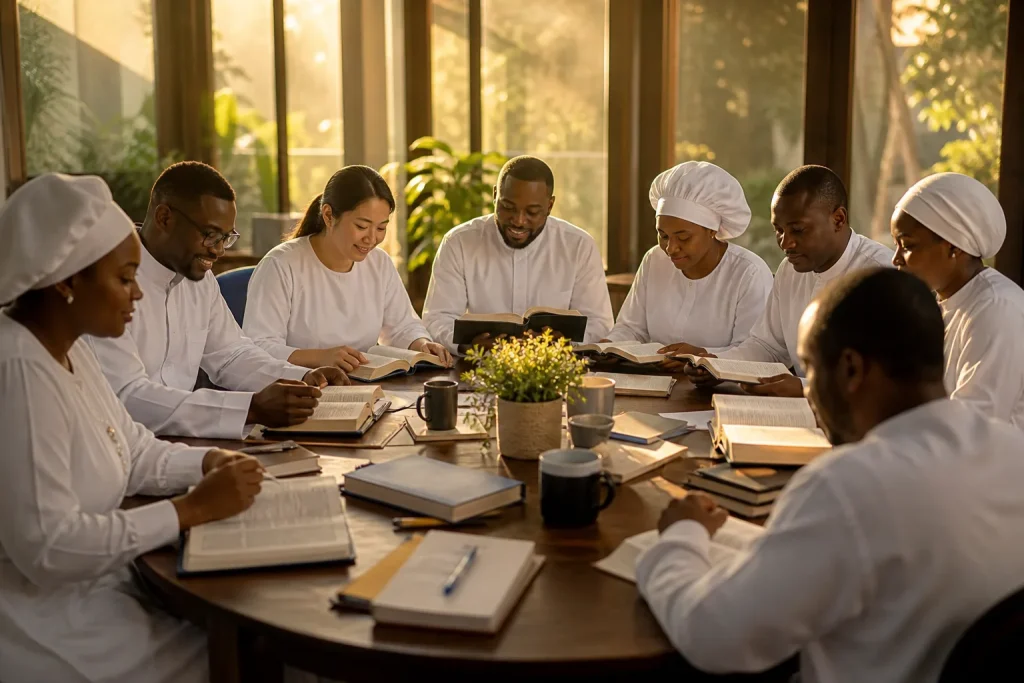
Create Small Groups for Scripture Study and Accountability
Gather weekly or bi-weekly in homes to study Scripture deeply and share honestly. Use questions like: “Where did you see God’s faithfulness this week?” “What sin are you struggling with?” “How can we pray for you?” Small groups create the relational container that large services cannot. Aim for 6-10 people—large enough for diversity, small enough for genuine knowing.
Practice Confession and Reconciliation
When conflict arises, do not ignore it. As Jesus taught, go to your brother privately, speak truthfully, seek reconciliation (Matthew 18:15-17). If your church lacks a culture of confession and reconciliation, initiate it. Be the first to say, “I was wrong; will you forgive me?” Reconciliation is fellowship’s lifeblood.
Share Meals and Life Together
In Scripture, eating together was fellowship’s primary expression. Invite church members to your home. Eat meals after services. Attend life events—births, weddings, funerals, graduations. These ordinary moments, shared with spiritual intention, deepen bonds remarkably. You do not need an agenda; you need presence.
Engage in Sacrificial Service
Volunteer together to serve the poor, sick, or marginalized. Visit nursing homes as a group. Help a young family move. Provide meals for someone undergoing treatment. Service binds hearts in shared mission and reveals whether fellowship extends beyond your church walls to Christ’s heart for the lost and suffering.
Develop Mentorship Relationships
Seek an older believer to mentor you. Invest in a younger believer. Spiritual mentoring is fellowship’s deepest form—one person pouring life, wisdom, and faith into another. Explore how spiritual growth flourishes within Christian community through intentional mentoring relationships.
Give Generously and Receive Humbly
When someone in your church faces hardship, give sacrificially—finances, time, resources. When you face hardship, receive graciously. Allowing others to serve you is as much an act of fellowship as serving them. It creates interdependence and reveals the mutual sufficiency Christ provides through His body.
Speak Truth with Love
If you notice a fellow believer drifting into sin or false doctrine, address it privately and lovingly. Ask questions before jumping to conclusions. Offer Scripture and prayer. The goal is restoration, not condemnation. As Galatians 6:1 instructs, “Brethren, if a man be overtaken in a fault, ye which are spiritual, restore such an one in the spirit of meekness; considering thyself, lest thou also be tempted” (KJV).
Overcoming Common Challenges in Practicing Fellowship
Authentic fellowship faces real obstacles. Here’s how to navigate them.
When someone betrays your trust: Forgiveness is fellowship’s heart. Extend the same grace Christ extended to you. If the relationship requires restoration, move prayerfully toward it. If distance becomes necessary for safety, offer it without bitterness.
When schedules conflict: Consistency matters more than perfection. Even a monthly gathering beats sporadic attempts. Quality of presence matters more than quantity. Show up faithfully, even when tired.
When you feel judged: Risk vulnerability anyway. Seek a safer sub-community within your church where authenticity is honored. Gradually, your openness may change your congregation’s culture.
When doctrinal differences emerge: Hold essential truths firmly while extending grace on secondary issues. Discuss disagreements in relationship, not from behind social media. Allow the Holy Spirit to work conviction in others’ hearts.
When busyness tempts isolation: Remember that fellowship is not optional—it is essential to your spiritual health. Guard time for community as fiercely as you guard time for individual prayer. Discover how to encourage believers during difficult times, including seasons of isolation.
The Transformed Life That Follows True Fellowship
When biblical fellowship practices take root in a congregation, transformation becomes visible. Believers grow in faith with greater speed. Moral and spiritual failures decrease as accountability increases. Marriages strengthen. Parenting improves. Witness to the world becomes more powerful. Depression, anxiety, and loneliness—the plagues of modern isolation—diminish as genuine connection fills the void.
The Celestial Church Worldwide Community has witnessed this transformation firsthand. Read about the community impact of faith lived out together in congregations worldwide. As believers commit to biblical fellowship practices, entire congregations experience revival not through emotional hype, but through the quiet, persistent power of people truly known, truly loved, and truly accountable to one another and to Christ.
A Practical Action Plan for This Week
Day 1-2: Identify one person in your church with whom you sense potential deeper fellowship. Pray for them. Ask God to open doors.
Day 3: Send them a message: “I’ve been thinking about our church community and how much I’d value deeper connection with you. Could we grab coffee or tea this week to talk about what God’s doing in our lives?”
Day 4-5: If you identify as a leader or have influence, propose one concrete fellowship initiative to your church leadership—a prayer group, a small group, a service project, or a mentoring structure.
Day 6: Share authentically with someone in your church. Tell them one struggle you’re facing. Ask for prayer. Model the vulnerability you want to see.
Day 7: Spend time in prayer asking the Holy Spirit to make biblical fellowship a reality—not in the abstract future, but in your specific church, starting with you.
FAQ: Biblical Fellowship Questions Answered
What is the biblical definition of fellowship in the Bible?
Biblical fellowship (koinonia in Greek) means participation, partnership, and sharing—specifically in the life, mission, and spiritual reality of Christ. It involves believers joining together not merely for social enjoyment, but for spiritual growth, mutual accountability, shared burdens, and Kingdom purpose. Bible.com’s reading plans and translations provide multiple ways to study the concept throughout Scripture. Fellowship is rooted in your common identity in Christ and sustained by the indwelling Holy Spirit. It expresses itself through shared meals, prayer, giving, service, and honest communication about your spiritual journey.
How can I develop genuine biblical fellowship in my local church?
Start with small, intentional steps. Find one or two others willing to meet regularly for prayer and Scripture study. Be vulnerably honest about your faith journey, struggles, and growth. Attend church consistently and involve yourself in a specific ministry or service area where you can build relationships over time. Invite people to your home. When conflict arises, address it privately and lovingly rather than ignoring it. Give sacrificially when others face need. Seek mentorship from a mature believer and offer mentorship to someone younger in faith. Most importantly, approach fellowship as spiritual discipline, not optional social activity. Return to Celestial Church of Christ’s main page or learn more about our community values and structure to understand fellowship as lived in our broader communion.
What are examples of biblical fellowship from Scripture?
The early Jerusalem church (Acts 2:42-47) devoted themselves to apostolic teaching, fellowship, breaking bread, and prayer while sharing possessions generously. Paul and Timothy’s relationship modeled spiritual mentoring and mutual encouragement across distance and danger. Priscilla and Aquila practiced hospitality and patient discipleship by privately correcting Apollos’ theology (Acts 18:24-26). The Philippian church partnered with Paul sacrificially in gospel advancement (Philippians 1:5). David and Jonathan’s friendship (1 Samuel 18-20) exemplified covenant loyalty and self-sacrificing love. Each example shows fellowship moving beyond pleasant interaction into shared mission, spiritual depth, vulnerability, and willingness to sacrifice for one another’s good.
Closing Reflection
Biblical fellowship is not a luxury for Christians with free time or compatible personalities. It is the essential environment in which disciples grow, thrive, and bear fruit. Jesus modeled it by choosing twelve men to live life with, share meals with, and entrust with His gospel. The apostles continued this pattern, building congregations where believers genuinely knew each other, prayed for each other, and held each other accountable to Christ.
You are invited into this ancient, beautiful practice. Not as spectator, but as active participant. Your church needs your vulnerability, your gifts, your faithfulness to show up. Others need your prayers, your listening ear, your gentle correction, your celebration of their victories. The Kingdom expands not through isolated believers, but through communities of believers knit together in authentic koinonia.
A Closing Prayer:
“Father, grant us the courage to seek biblical fellowship beyond surface pleasantries. Open our hearts to genuine vulnerability and our ears to hear one another’s real stories. Bind us together by Your Spirit in ways that transcend preference, personality, and convenience. Make us the kind of community that reflects Christ’s love so visibly that the world recognizes His presence among us. Teach us to pray for one another fervently, to speak truth lovingly, to serve sacrificially, and to hold one another accountable to Your Word. Transform our churches from comfortable gatherings into covenant communities. In Jesus’ name, amen.”
Trusted Resources for Further Study
For deeper study see BibleGateway, Bible.com, Britannica, WHO, and Library of Congress.